
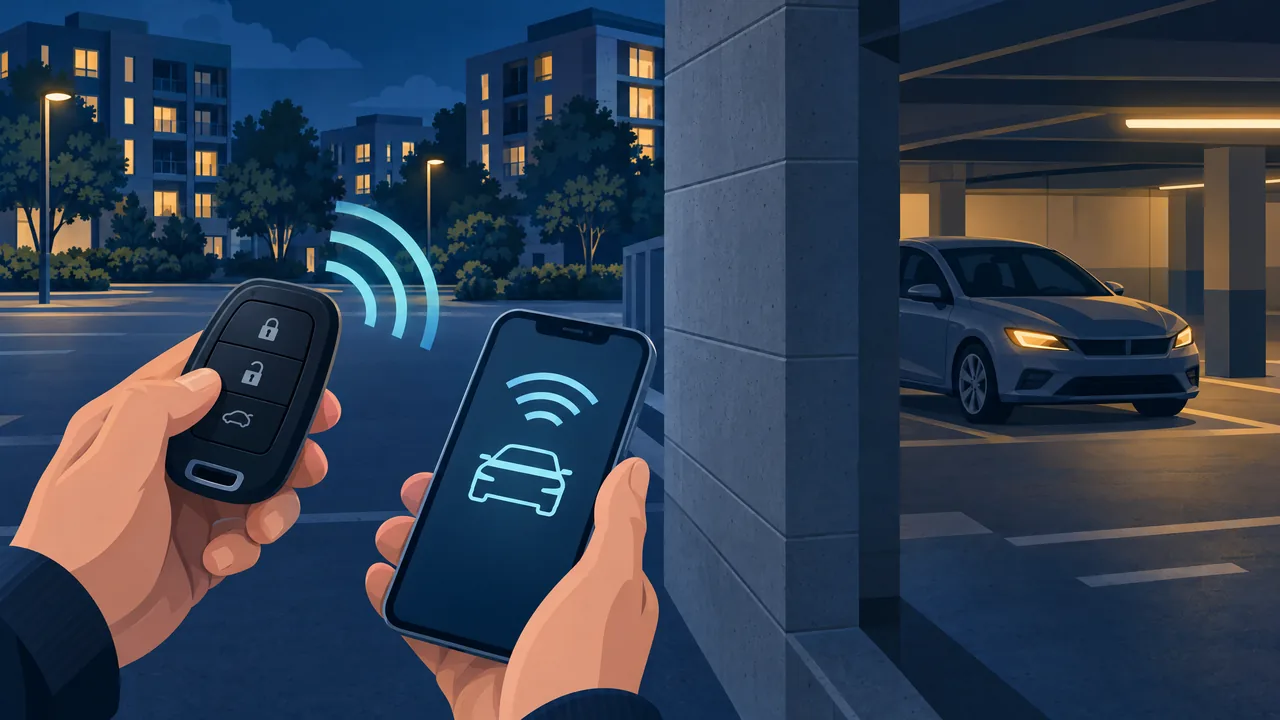
Remote Start Range: Why Your Parking Location Matters
An advertised remote start range is not a promise that a command will reach your car from your office, apartment or usual shopping stop. For Pittsburgh-area drivers, the useful question is not just how far away the vehicle is. It is what lies between you and it, and whether you receive confirmation.
Look at the route the signal must travel
Firstech explains that remote transmitters communicate over radio frequencies with a control module installed in the vehicle. The range caveats on 21st Century Sound's remote-starter installation page identify buildings, trees, radio-frequency interference and vehicle placement as factors that can affect communication.
A parking space across an open lot is therefore a different situation from one behind a building or inside a parking structure. Walls and columns are worth describing to an installer, even when the car seems close. Do not convert a maximum-range label into a guaranteed distance through your building, or assume an outdoor demonstration predicts reception from every indoor room.
Separate reach from returned confirmation
A one-way remote sends a command without receiving the vehicle's confirmation back. Its button light alone is not proof that the engine started. Compustar's one-way and two-way explanation describes two-way remotes that return audible and visual feedback, useful when the car is out of sight.
Two-way describes feedback, not a guarantee that a signal will get through. The Firstech manual hosted by Arctic Start qualifies returned communication as being within range. Ask which indication means the command was sent and which confirms successful remote starting. If confirmation does not arrive, treat the result as unconfirmed; do not assume either success or failure. An engine-running indication also does not tell you the cabin has reached your preferred temperature.
Choose the control method around your parking habits
If your existing factory-fob control meets your needs, there is no need to choose another method just because its advertised distance is larger. Ask whether factory-fob operation is supported by any proposed installation and which range specification applies to that control. Keeping the original fob does not by itself establish the reach of a separate remote kit.
A dedicated RF remote is worth comparing when you want different reach or returned feedback. Ask about the actual remote and receiver combination, rather than treating all aftermarket remotes as equivalent. Compare one-way versus two-way separately from range.
Connected-phone control uses a different communication route. DroneMobile requires installed LTE hardware connected to a compatible system, the app and an active service subscription. Do not assume downloading an app connects an existing factory starter; have the installer confirm the integration and any additional hardware.
Phone control is not guaranteed reception everywhere. DroneMobile's connectivity guidance says commands depend on phone internet and the vehicle module's cellular connection. Cement and underground parking structures can prevent communication. Strong signal on your phone does not prove the module has service; they may use different networks.
Bring these questions to the installer
- Provide the exact year, make, model, trim, engine, transmission, keyed or push-button start, and any existing remote-start equipment. Ask which configuration is supported.
- Describe where you stand and where you park at home and work, including intervening buildings and parking levels. Ask what can reasonably be checked without promising future reception.
- Ask for a demonstration of successful-start feedback and error indications. Have remote battery condition, antenna or module placement and relevant settings checked if communication is inconsistent.
- For phone control, confirm hardware, local vehicle-side connectivity, current subscription requirements and what alternatives remain if the app cannot connect.
Garage examples describe communication barriers, not permission to run an engine indoors. CDC guidance says never run a car in a garage attached to a house, even with the garage door open. Follow your vehicle's operating instructions and parking-location rules.
Related Posts
Before Replacing Your Radio: Check the Factory Features You Want to Keep
Replacing a radio? Check steering-wheel buttons, cameras, parking alerts, factory amplifiers, USB ports and vehicle settings before requesting a quote.
11/17/2026

North Park Holiday Laser Show 2026: Tickets and Visit Planning
North Park's 2026 Holiday Laser Show runs December 17–23, with tickets scheduled for November 30. Plan the vehicle ticket, pool-lot arrival and FM soundtrack.
11/17/2026

North Park Ice Skating: Plan the Session Before the Trip
Plan a North Park skating outing around a verified session, rental needs and conditions. Current official listings do not yet confirm a regular 2026–27 schedule.
11/16/2026
Dash Cam Memory Cards: Match the Specs and Protect Important Clips
Match a memory card to your exact dash cam, check overwrite and deletion settings, and copy a wanted recording before formatting or removing the card.
11/15/2026